Approximating pi with polygons
esheets.io/approximating-pi-with-polygons
Approximating Pi with Polygons is a free interactive visualisation that brings a classical mathematical idea to life: as a regular polygon gains more sides, it becomes a better and better approximation of a circle. The tool shows this process by drawing both an inscribed polygon (fitted inside the circle) and a circumscribed polygon (fitted outside the circle) simultaneously, and computing the \(π\) approximation each one gives. The result is a direct, visual demonstration of why π is what it is, and how mathematicians have estimated it for centuries. This also helps to connect the circumference of a circle to the idea of perimeter, which pupils will already be familar with.
How the visualisation works
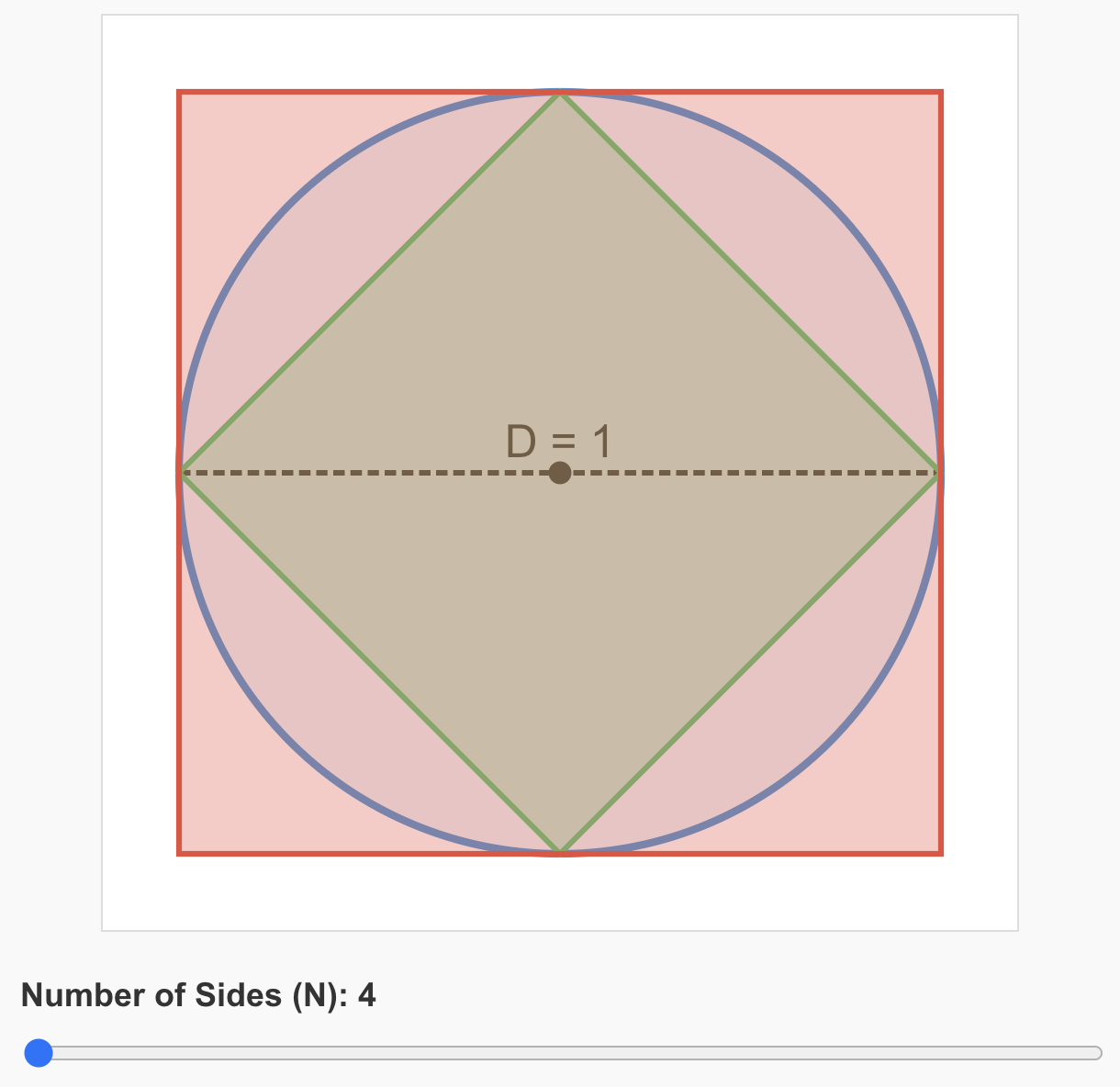
A circle of fixed diameter \(D = 1\) sits at the centre of the diagram. Two regular polygons are drawn around it:
- The inscribed polygon (shown in green) fits inside the circle, with all its vertices touching the circumference. Its perimeter is always less than the circumference of the circle, so it gives a lower bound for \(π\).
- The circumscribed polygon (shown in red) fits outside the circle, with each side tangent to the circumference. Its perimeter is always greater than the circumference, so it gives an upper bound for \(π\).
Because the circle has diameter 1, its circumference equals π exactly. So the approximation for each polygon is simply its perimeter divided by 1, the perimeter itself. The two polygon perimeters squeeze the true value of \(π\) from below and above simultaneously.
A Number of Sides (N) slider runs from 4 to 20 in integer steps. As N increases, both polygons visibly close in on the circle and the two approximations converge toward \(\pi \approx 3.1415926535...\), which is displayed as a reference at the bottom of the tool.
Reading the table
Below the diagram, a table displays three rows for both polygons at the current value of N:
| Property | Inscribed Polygon | Circumscribed Polygon |
|---|---|---|
| Side Length | — | — |
| Perimeter | — | — |
| \(π\) Approximation (Perimeter / Diameter) | — | — |
At \(N = 4\) (a square), the inscribed polygon gives \(2.8284271\) and the circumscribed polygon gives \(4.0000000\), a wide interval. By \(N = 20\), the two approximations are already very close to one another and to the reference value of \(π\).
Getting started
- Note the starting state at \(N = 4\): a square inscribed and a square circumscribed around the circle. Read both \(π\) approximations from the table.
- Drag the slider to the right to increase N. Watch the polygons gain sides and narrow in on the circle's boundary.
- Read the table at different values of N, tracking how the lower and upper bounds change.
What makes it rich
The tool makes a subtle but important idea concrete. Pupils often encounter \(π\) as a fixed fact to memorise, with little sense of where it comes from or why it is approximately 3.14. This visualisation answers that question visually and numerically.
At \(N = 4\), the lower bound (2.828...) and upper bound (4.000) are far apart. It is clear from looking at the diagram why neither square is a good approximation of the circle. As N increases, the gap narrows, and pupils can see the polygons smoothing out, their jagged edges gradually becoming indistinguishable from the curve. The table makes the convergence precise.
A key conceptual point for pupils to notice is that the lower bound always increases and the upper bound always decreases, and the two are always on opposite sides of the true value of \(π\). This is the idea of bounding or trapping a value, a powerful technique that recurs across mathematics.
Common pupil misconception: pupils sometimes assume that taking more sides will eventually reach \(π\) exactly. The tool is a useful prompt for discussing why this cannot happen for any finite N. The polygons always have straight edges, so their perimeters are always either too small or too large.
Suggested discussion questions
- At \(N = 4\), the circumscribed square gives 4. Can you see from the diagram why that makes sense?
- As N increases, does the lower bound or the upper bound seem to converge faster? Can you explain why?
- At what value of N do both approximations agree to 2 decimal places? To 3?
- Archimedes used a 96-sided polygon to estimate \(π\) as lying between \(3\tfrac{10}{71}\) and \(3\tfrac{1}{7}\). How close do N = 20 values get to that accuracy?
- Why can no regular polygon ever give the exact value of \(π\)?
Classroom uses
Whole-class demonstration: Project the tool and begin at \(N = 4\). Ask pupils to predict what will happen to the two approximations as N increases, then drag the slider slowly and pause for discussion at each step. The visual and numerical changes reinforce each other.
Introducing \(π\): Use the tool before any formal definition of \(π\). Let pupils observe that the perimeter-to-diameter ratio of the circumscribed and inscribed polygons converges toward the same value, then name that value as \(π\).
Paired investigation: Ask pupils to record both approximations at every integer value of N in a table of their own. They can then compute the interval width (upper bound minus lower bound) at each stage and observe how quickly it shrinks.
Connecting to history: Pair with a short discussion of Archimedes' method of exhaustion. The tool is a direct digital descendant of the approach he used around 250 BC. Pupils can compare the accuracy achievable at \(N = 20\) with what Archimedes calculated by hand with \(N = 96\).
Extension: Challenge pupils to predict what the side length formula would look like for the inscribed polygon, using right-triangle trigonometry. At \(N\) sides, the inscribed polygon's side length is \(\sin(180^\circ / N)\), so the perimeter is \(N \sin(180^\circ / N)\). Pupils can verify this against the tool's table values.
Pedagogical roots
The method shown here is a digital version of the method of exhaustion, attributed to Eudoxus of Cnidus and developed extensively by Archimedes in his treatise Measurement of a Circle (c. 250 BC). The idea of trapping an unknown quantity between a lower and upper bound, and then tightening those bounds, is one of the foundational ideas of mathematical analysis, and an early ancestor of the concept of a limit. The tool makes this historical and conceptual arc accessible to secondary pupils through direct manipulation and immediate numerical feedback.