Nets of Solids (GeoGebra)
geogebra.org/math/solids
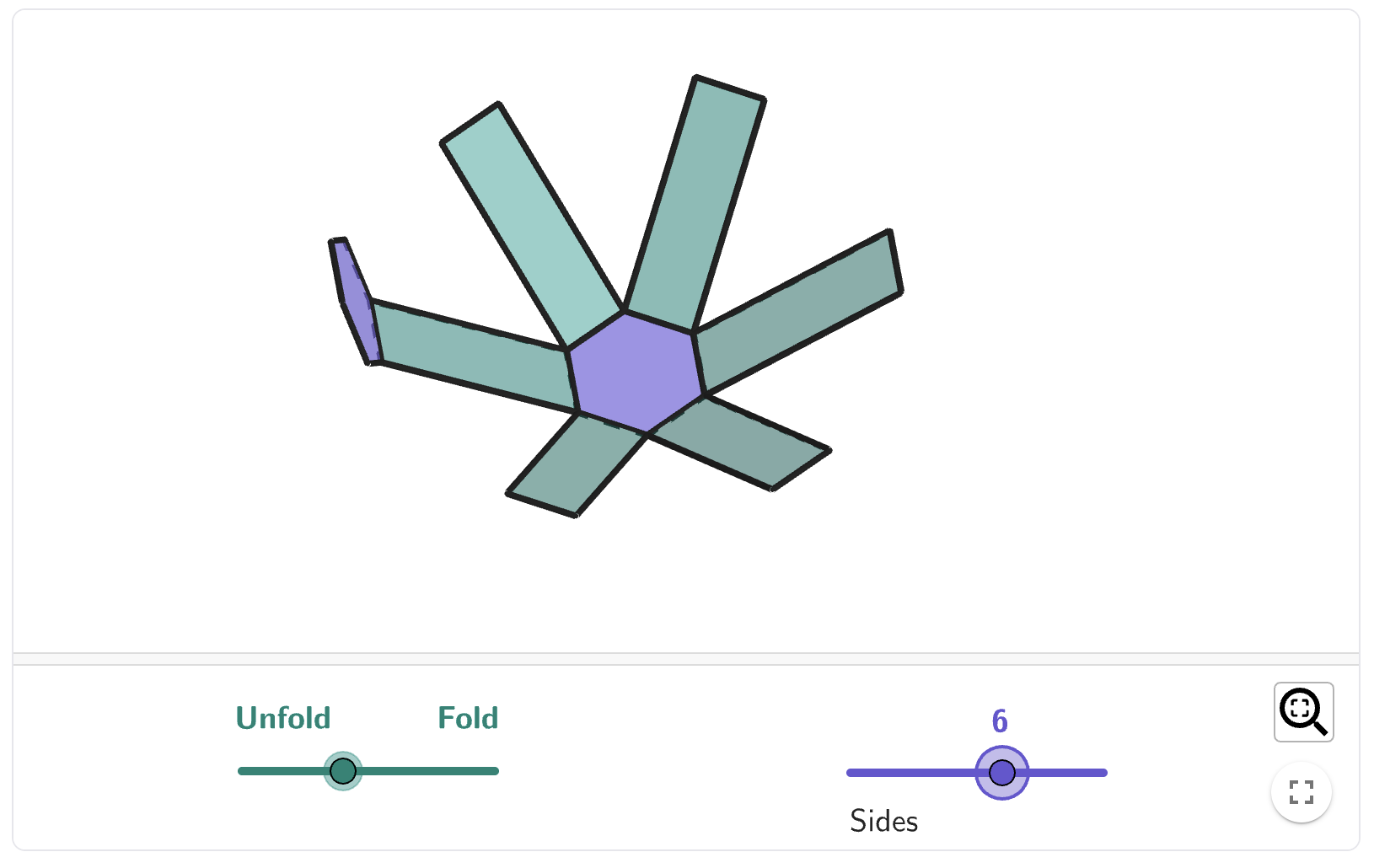
This collection provides dynamic, foldable representations of 3D solids, transforming abstract surface area problems into concrete visual tasks. By animating the process of "unfolding" a shape, the tools help pupils understand how 2D templates map onto 3D vertices, edges, and faces.
How the tool works
The nets tools are designed to illustrate the transition between 2D and 3D space.
- Folding Animation: A central slider allows pupils to "open" and "close" the net at their own pace, making the connection between specific edges and faces clear.
Classroom Uses
Deriving Surface Area Formulae
The net of a cylinder is a classic point of confusion. Using this tool, pupils can see that the "side" of a cylinder is actually a rectangle.
Example: Use the cylinder tool to show that the length of the rectangle is equal to the circumference of the circular base (\(2\pi r\)). This makes the formula \(SA = 2\pi r^2 + 2\pi rh\) logical rather than abstract.
Visualising Properties of Solids
Help pupils understand Euler’s formula (\(V - E + F = 2\)) by counting properties on the net before folding it.
Strategy: Have pupils count the faces on the flat net, then fold it to see how many edges "merge" when the solid is formed. This highlights that while faces are distinct on a net, edges are often shared.
Teaching Strategy
- Exploration: Ask pupils to predict which face will be "opposite" a specific one when folded.
- Digital Check: Use the tool to fold the net and check their predictions.
- Surface Area Challenge: Give pupils the dimensions of a 3D cuboid. Have them use the tool to identify all \(6\) faces and calculate the area of each one individually before summing them.
- Curved Surface Focus: Use the cone and cylinder tools to discuss why the nets of curved solids require "flat" shapes (circles and rectangles).
Pedagogical Value
Standard textbook "net" diagrams are often static and difficult for pupils with poor spatial awareness to interpret. The dynamic "open/close" nature of these GeoGebra applets allows pupils to physically see how 2D area becomes 3D surface area. It removes the "guesswork" from identifying nets and provides a robust framework for calculating total surface area by showing the constituent parts of a solid in their simplest 2D form.