The Almanac of Interesting Numbers
mathigon.org/almanac
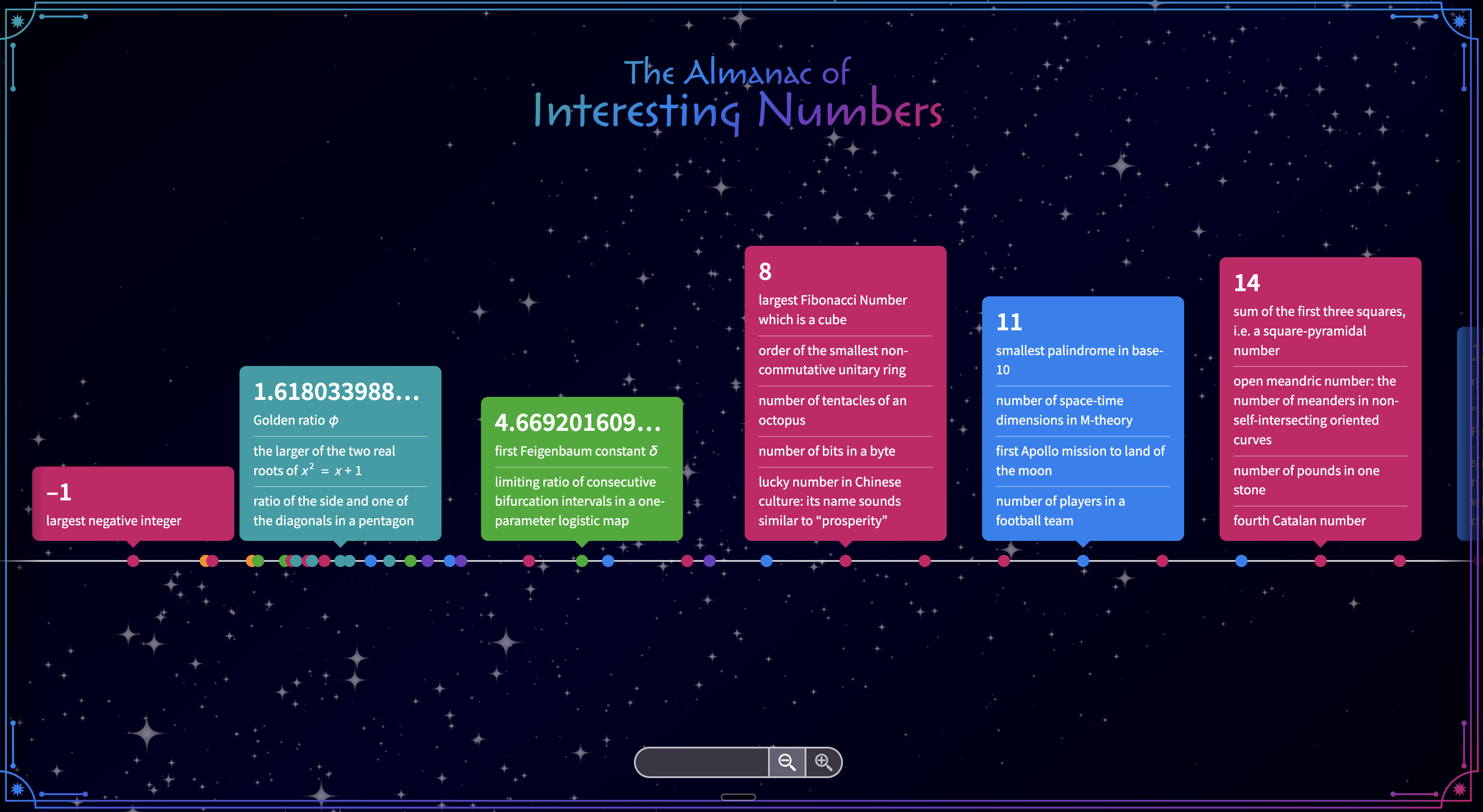
The Almanac of Interesting Numbers is an interactive, infinite timeline designed to foster curiosity. Rather than treating numbers as abstract symbols, the tool presents them as a "digital museum" of mathematical constants, scientific facts, and cultural trivia. By allowing pupils to scroll from \(-1\) through to astronomical scales, the Almanac makes the vast landscape of number theory feel tangible and interconnected.
The tool features hundreds of entries covering:
- Mathematical Constants - From \(\pi\) and \(e\) to the Golden Ratio (\(\phi\)) and Feigenbaum constants.
- Number Properties - Identifying primes, Fibonacci numbers, perfect numbers, and palindromes.
- Scientific Connections - Linking numbers to the speed of light, DNA nucleobases, or the dimensions in M-theory.
- Cultural Trivia - Exploring the significance of numbers in history, literature, and international cultures.
How the tool works
The interface consists of a dynamic number line set against a celestial backdrop. Numbers are represented by coloured dots; clicking a dot reveals a fact card containing concise, high-level descriptions of that number’s significance.
- Navigation: click and drag to move left or right along the timeline.
- Scaling (Zoom): Using the zoom controls at the bottom, users can change the granularity of the timeline. Zooming in reveals fractions and decimals (like \(1.414...\)), while zooming out allows for rapid travel toward millions, billions, and beyond.
- Search: A dedicated search bar allows users to jump instantly to a specific number to explore its properties.
Getting started
- Explore the timeline by dragging the number line or using a scroll wheel.
- Zoom in and out using the magnifying glass icons to discover constants hidden between integers.
- Search for a favourite number to see its mathematical or cultural significance.
- Click a number on the line to see the properties or historical context.
Categorising Interest
| Category | Example Entry | Why it matters |
|---|---|---|
| Pure Maths | 1.618... (Golden Ratio) | Connects geometry (pentagons) to algebraic roots. |
| Properties | 8 (Fibonacci Cube) | Shows the rare intersection of different number sequences. |
| Science | 11 (M-theory) | Links abstract number theory to the fundamental laws of physics. |
| Culture | 4 (Unlucky numbers) | Demonstrates how mathematics intersects with global sociology. |
Why this is powerful
Humanising Mathematics:
The Almanac moves maths beyond the abstract by showing that numbers have "personalities" and histories. Seeing that the number \(17\) is the number of possible wallpaper groups or that \(11\) relates to the Apollo moon landing helps pupils see math as a language used to describe the entire universe, not just a set of rules to follow.
Developing Number Sense through Variation:
By zooming into the space between \(1\) and \(2\), pupils encounter the density of the number line. Seeing \(\sqrt{2}\), \(\phi\), and \(e\) positioned relative to one another builds a visual intuition for the value of irrational numbers that a standard calculator display cannot provide.
Classroom uses
"Number of the Day": Start a lesson by projecting a random number from the Almanac.
Mathematical Scavenger Hunt: Give pupils a list of properties (e.g., "Find a number that is both triangular and square" or "Find a number related to an octopus") and have them use the navigation and zoom tools to locate them.
Cross-Curricular Links: Use the Almanac to bridge Maths with Science or History. For example, when studying the solar system, find the numbers associated with planetary orbits or the speed of light to provide a mathematical anchor for those facts.
Discussion Questions from the tool:
- Why do you think some numbers have many cards while others have none?
- How many 'special' numbers can you find between 1 and 2?
- If a number is 'lucky' in one culture but 'unlucky' in another (like 4 or 8), what does that tell us about how humans use maths?