Prime Factor Wall Game
m4th5.co.uk/prime-factor-wall
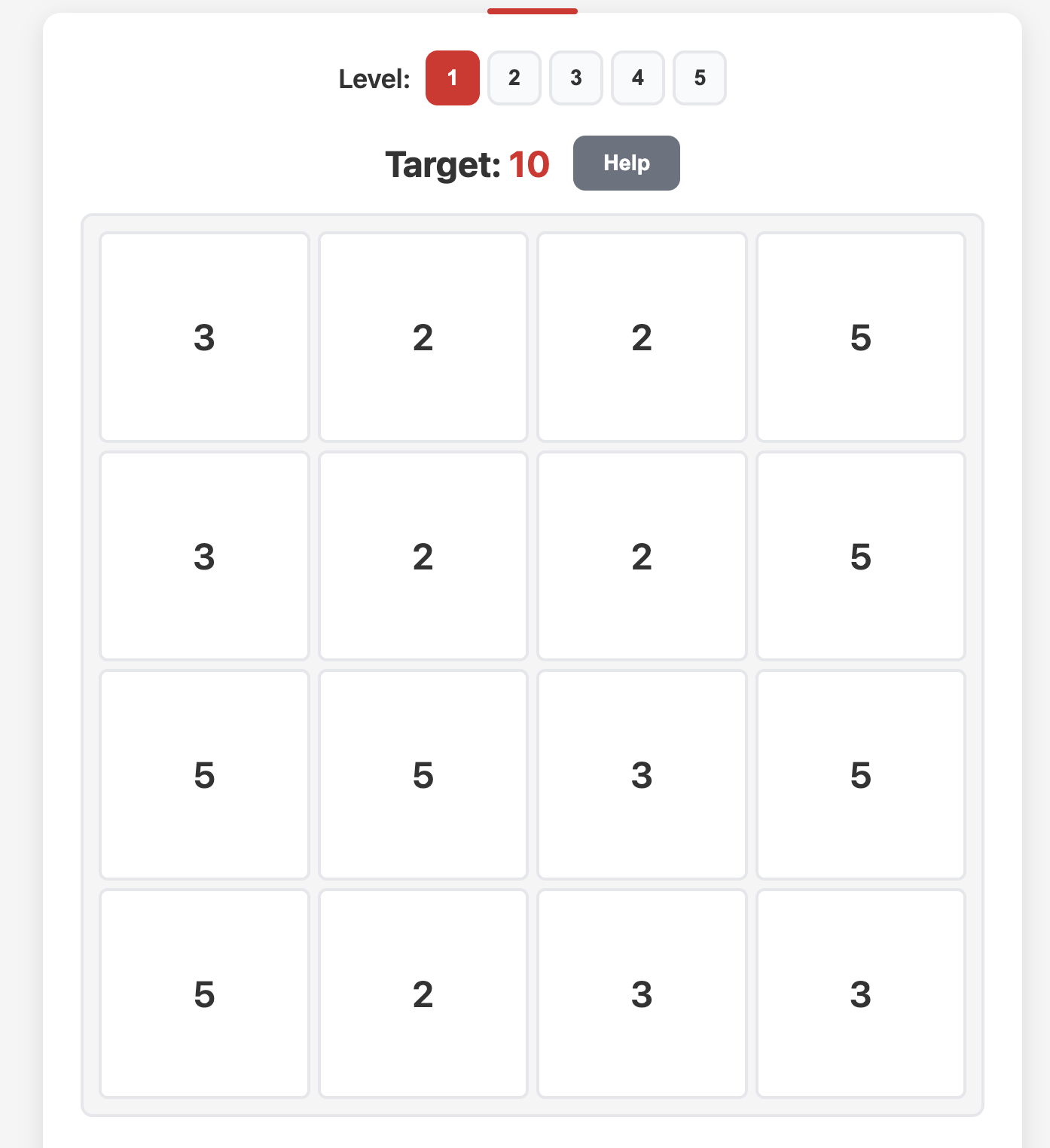
The Prime Factor Wall is a fast-paced fluency game designed to help pupils internalise the multiplicative "DNA" of numbers. Rather than a static diagram, it is a race against the clock where players must identify and select the prime factors that multiply together to reach a specific target number.
How the tool works
The game is structured as a grid-based challenge that scales in difficulty:
- The Target: A composite number is displayed at the top of the screen (e.g., Target: 10).
- The Grid: A wall of prime number tiles (2, 3, 5, 7, etc.) is presented. Players must click the tiles that, when multiplied, equal the target. For a target of 10, a player would need to find and click a '2' and a '5'.
- Levels 1-5: The game features five levels of increasing complexity. Higher levels introduce larger target numbers and a more crowded "wall" of prime factors, requiring faster mental retrieval and more complex prime factorisations.
- The Clock: An elapsed timer runs throughout the session. This encourages automaticity, as pupils move from calculating factors to recognising them instantly.
- Feedback: The game provides immediate visual feedback, clearing successfully matched tiles and tracking progress through the level.
Classroom Uses
The game is best used as a high-energy "starter" or "plenary" to move prime factorisation from a slow, procedural task (like drawing factor trees) to a rapid mental skill.
Building Multiplicative Automaticity: In the early stages of learning prime factorisation, pupils often treat it as a chore. Using the Prime Factor Wall as a quick warm-up helps pupils recognise common "building blocks" (e.g., seeing 12 and immediately thinking without needing to pick up a pen.
Developing Strategic Scanning: As the levels increase, pupils can't just find any factors; they have to find them within the available grid. This encourages them to look for "clues". For example, if the target is 30, they might look for a 5 first, knowing the remaining factors must multiply to 6.
Competition and "Personal Bests": The timer allows for low-stakes competition. Pupils can compete against their own previous times or against the class average. This is particularly effective for pupils who enjoy "gamified" learning and thrive on beating the clock.
Teaching Strategy: "The Speed Run Challenge"
- Level Selection: Assign a specific level (e.g., Level 3) to the whole class.
- The Sprint: Give pupils exactly two minutes to complete as many targets as possible or to finish the level.
- The Strategy Break: Pause the game and ask: "Which target numbers slowed you down? Which prime factors were the hardest to find in the grid?"
- The Second Run: Allow pupils to try the same level again. They will almost always see a time improvement as their "multiplicative recognition" kicks in.
Pedagogical Value
The Prime Factor Wall addresses the gap between understanding prime factorisation and being fluent in it. In the context of GCSE or KS3, pupils who can factorise numbers mentally and instantly have a significant advantage when simplifying fractions, finding HCF/LCM, or working with surds. By turning this into a "search and match" game, the tool builds the necessary retrieval strength for these more complex topics.