Prime Tiles
mathsbot.com/manipulatives/primeTiles
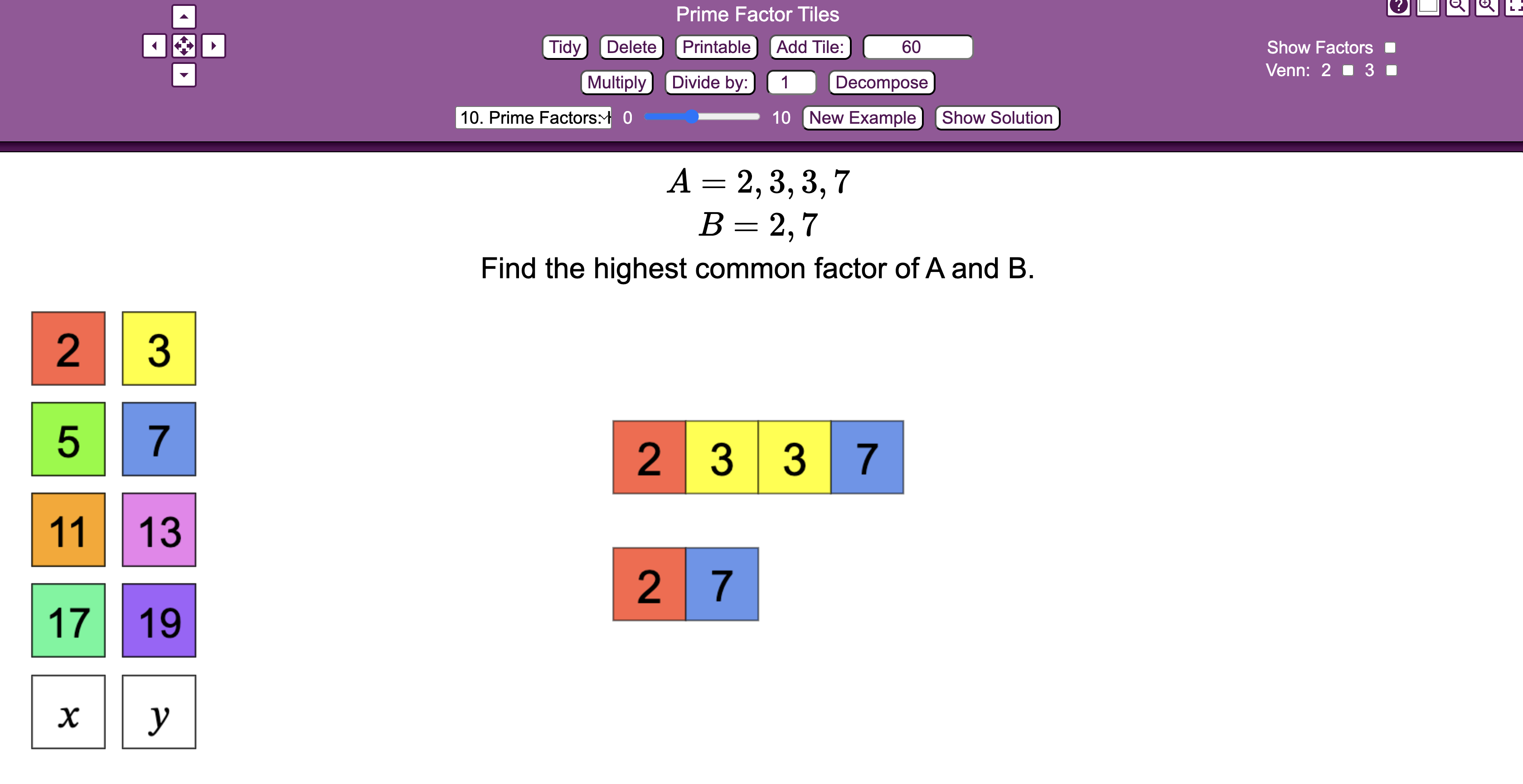
Prime Tiles is a virtual manipulative designed to help pupils deconstruct composite numbers into their fundamental building blocks. It provides a visual and interactive environment for KS3 and GCSE pupils to explore the multiplicative structure of integers, moving beyond procedural factor trees to a deeper understanding of the "DNA" of numbers.
How the tool works
The interface consists of a workspace where numbers are represented as individual tiles. It simplifies complex arithmetic by allowing pupils to physically manipulate the components of a number.
- Splitting Tiles: Select any composite number tile and click "decompose" to split it into its prime factors (e.g., decomposing \(12\) results in two \(2\) tiles and one \(3\) tile).
- Combining Tiles: Dragging one tile onto another multiplies them, creating a new composite tile. This allows for the rapid construction of large numbers from their primes.
- Colour-coded Primes: Each prime number is assigned a unique colour, allowing pupils to recognise the prime signature of a number at a glance.
- Rapid Duplication Select a tile and use the arrow keys to duplicate.
- Built in Questions Select from a range of prime factor related questions to challenge pupils.
Classroom Uses
Visualising the DNA of Numbers
Prime Tiles allows pupils to see that every integer has a unique "fingerprint." By breaking down various numbers, pupils can begin to see how the same primes are recycled to create different values.
- Strategy: Give pupils a target number like \(60\) and ask them to find all the different ways they can "build" it using the prime tiles \(2, 2, 3,\) and \(5\). This reinforces that the order of multiplication does not change the identity of the number.
Unpacking HCF and LCM
The tool makes the abstract concepts of Highest Common Factor and Lowest Common Multiple visible. By placing the prime tiles for two numbers side-by-side, pupils can identify which "blocks" they share.
- Example: To find the HCF of \(18\) (\(2 \times 3 \times 3\)) and \(24\) (\(2 \times 2 \times 2 \times 3\)), pupils look for the tiles present in both set, one \(2\) and one \(3\), leading to an HCF of \(6\).
Investigating Square and Cube Numbers
Pupils can explore what "makes" a square number by looking at the parity of the tiles. By observing that a square number always has pairs of identical prime tiles, they develop a structural understanding of powers.
- Strategy: Ask pupils to "split" \(16, 36,\) and \(100\). They will quickly notice that every prime tile in the collection has a "partner," making multiplicative thinking about square roots much more intuitive.
Teaching Strategy
- Identify the Target: Display a large composite number, such as \(72\), on the main board.
- Predict the Factors: Ask pupils to write down what "colours" (primes) they think will appear when the tile is split.
- The Big Reveal: Click the tile to decompose it into \(2, 2, 2, 3,\) and \(3\).
- Reconstruct and Compare: Ask pupils to drag tiles together in different orders, for example, \(2 \times 2 \times 2 = 8\) and \(3 \times 3 = 9\). Show that \(8 \times 9\) still returns them to the original \(72\) tile.
- Generalise: Repeat with a different number and ask pupils to identify what the two numbers have in common "under the hood."
Pedagogical Value
Prime Tiles significantly reduces cognitive load by removing the need for pupils to perform mental divisions while trying to understand the concept of factorisation. While pen-and-paper factor trees often become messy and hide the final product, this tool keeps the mathematical structure front and centre. It allows teachers to teach "across the grain," prompting pupils to notice patterns in the prime signatures of numbers that would otherwise remain invisible. It is an essential tool for visualising the DNA of numbers and building a robust foundation for algebraic manipulation later in the curriculum.