Target 1000
mrchapmanmaths.com/number/target1000
Target 1000 is a place-value strategy game that challenges pupils to build two three-digit numbers with a sum closest to \(1000\). It serves as an excellent starter or plenary for KS2, KS3 and KS4 classes to reinforce mental addition, estimation, and probability-based decision-making.
How the tool works
The interface provides a clean, interactive grid where pupils must make rapid decisions about the "value" of a digit before the next one is revealed.
- Dynamic Digit Generation: Clicking "ROLL" generates a random digit from \(1\) to \(9\).
- Strategic Placement: Pupils click empty boxes to place the digit. The grid is colour-coded to aid navigation: Blue for \(100\)s, Green for \(10\)s, and Orange for \(1\)s.
- The Trash Can: To manage risk, pupils are permitted to discard exactly one unwanted digit per game.
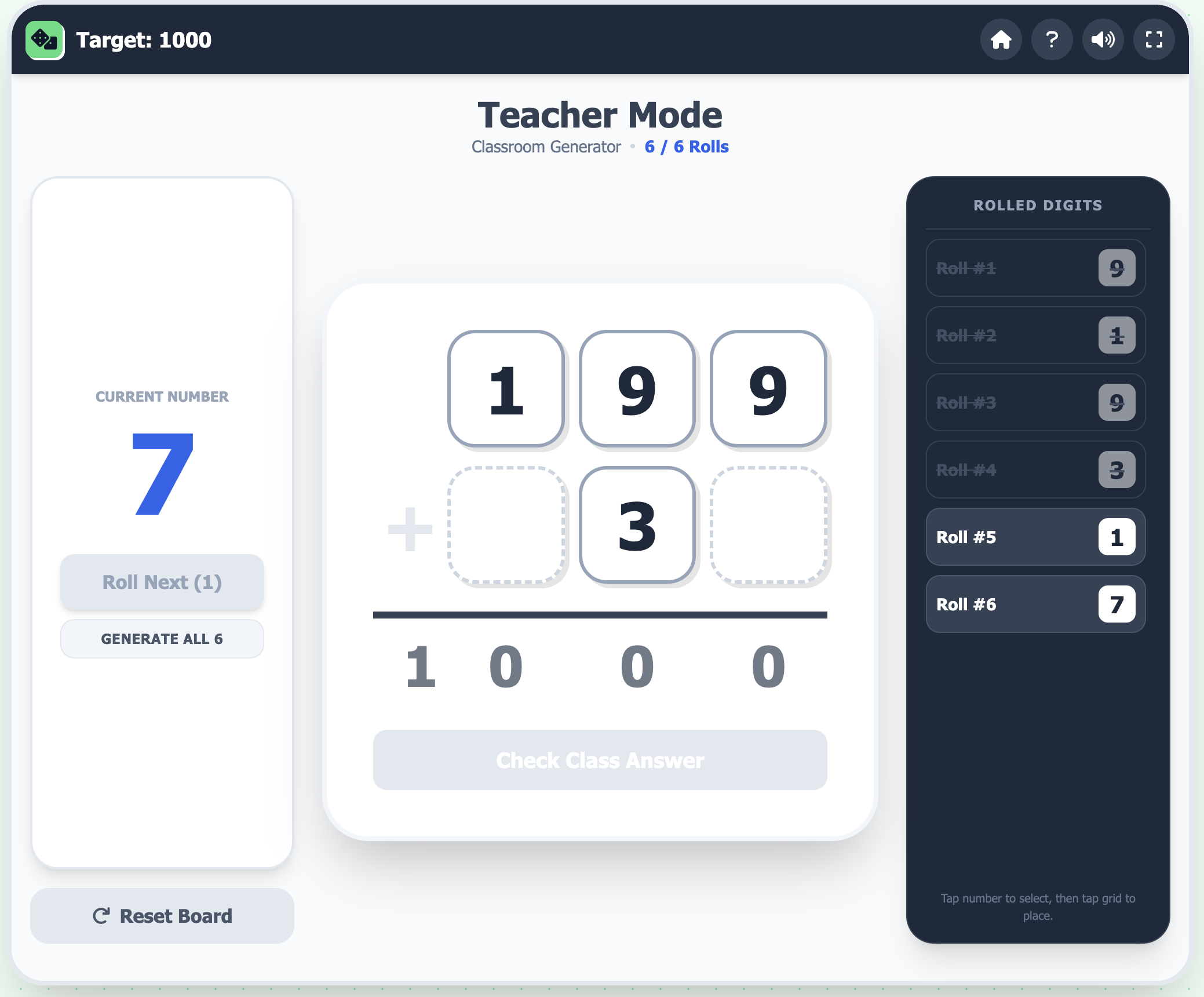
- Teacher Mode: This mode allows a teacher to generate a synchronised set of 6 numbers for the entire class to use, either one at a time or all at once, facilitating a fair competition to see who can get the closest to the target.
Classroom Uses
Mastering Place Value and Regrouping
The game forces pupils to look at the mathematical structure of addition. To reach exactly \(1000\), pupils must account for "carrying" or regrouping across columns.
- Strategy: Challenge pupils to explain their placement of a \(9\) in the \(10\)s column. Do they hope for a small unit to avoid pushing the \(100\)s column over the limit?
Probability and Risk Management
Because digits are rolled one at a time, pupils must weigh the "cost" of a slot. This encourages them to think about the likelihood of future rolls.
- Example: If a pupil has already placed a \(4\) and a \(5\) in the \(100\)s column, rolling a \(7\) creates a dilemma. Should they "trash" it, or place it in the units column to save the \(10\)s for something smaller?
Directed Numbers and Error Analysis
After the sum is calculated, the focus shifts to the "difference" from the target.
- Strategy: Ask pupils to calculate their "score" as a directed number (e.g., \(+14\) or \(-3\)). This is an excellent bridge into absolute value and subtracting from \(1000\).
Teaching Strategy
- Open Teacher Mode and display it on the main board to generate the first digit for the class.
- Pause after the first roll. Ask: "Which column is the most 'expensive' to place this in?" and "Who is trashing this immediately?"
- Generate the remaining digits one by one, allowing \(10\)–\(15\) seconds for pupils to commit the number to their own grid on a mini-whiteboard.
- Once all 6 digits are placed, have pupils calculate their total sum.
- Identify the "Class Champion" and ask them to explain their placement logic.
Pedagogical Value
Target 1000 is a great companion to standard addition practice because it uses the "process" of adding while increasing the focus on the mathematical structure of the base-10 system. It forces pupils to engage in multiplicative thinking regarding place value, recognising that a \(2\) in the hundreds column has a vastly different impact than a \(2\) in the units. The inclusion of the "Trash Can" introduces a strategic element that rewards pupils for understanding the distribution of digits \(1\)-\(9\), making the nature of our number system visible through play.